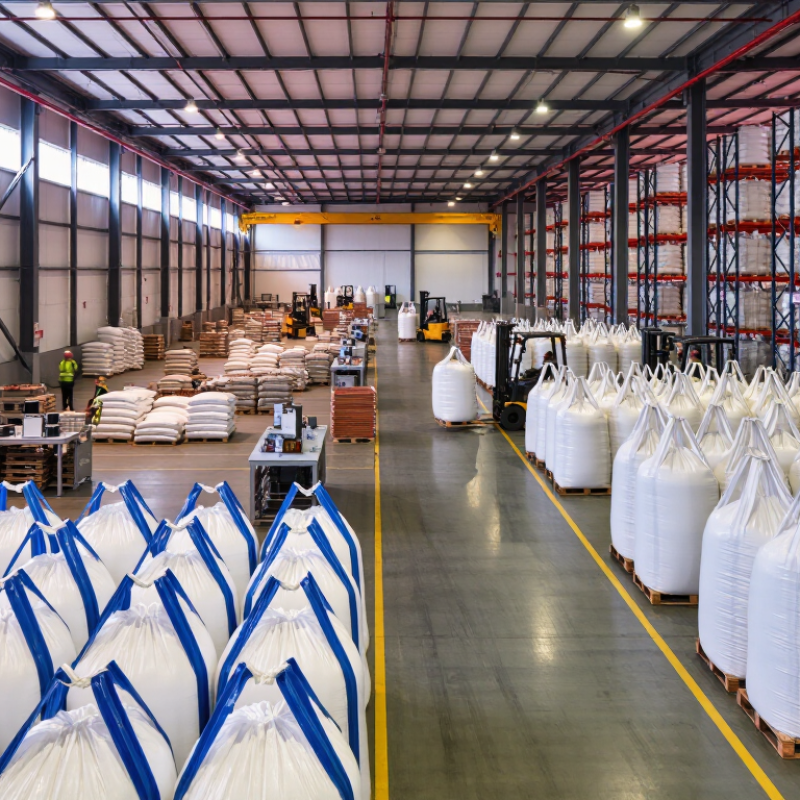
| Product Definition | Flexible Intermediate Bulk Container (FIBC), also called a bulk bag or jumbo bag | Provides a standardized way to package, handle, store, and transport dry bulk materials. |
| Main Material | Woven polypropylene fabric, commonly with a laminated or unlaminated surface | Polypropylene offers a strong, lightweight, moisture-resistant structure suitable for many dry products. |
| Typical Safe Working Load | Approximately 500–2,000 kg per bag, depending on design and certification | The required load rating helps buyers match the bag to the product weight and handling equipment. |
| Common Capacity by Volume | About 0.5–2.0 m³, with exact capacity determined by dimensions and product density | Volume selection supports efficient container utilization and reduces unnecessary shipping space. |
| Safety Factor | Common ratings include 5:1 for single-trip use and 6:1 for reusable designs | The safety factor indicates the relationship between the bag’s tested breaking load and its rated working load. |
| Typical Bag Dimensions | Common footprints range from approximately 85 × 85 cm to 95 × 95 cm; height varies by capacity | Standardized footprints simplify palletizing, warehouse storage, and filling-line compatibility. |
| Lifting Options | Four corner loops, cross-corner loops, sleeve loops, or specialty lifting configurations | The lifting design must match forklifts, cranes, filling systems, and unloading procedures. |
| Filling and Discharge | Top options include open top, duffle top, or filling spout; bottom options include flat bottom, discharge spout, or iris closure | The correct configuration reduces product loss and improves filling and controlled discharge efficiency. |
| Product Compatibility | Used for grains, seeds, feed, minerals, chemicals, powders, construction materials, and recycled products | A supplier can recommend fabric, coating, liner, and closure features according to product properties. |
| Liner Requirement | Optional polyethylene or polypropylene liners are used when enhanced moisture, dust, or contamination protection is required | Liners can improve product protection during long-distance and multi-modal transportation. |
| Available Surface Treatments | Laminated, coated, breathable, antistatic, conductive, or UV-treated fabric options | Special treatments help address dust control, static electricity, outdoor exposure, and moisture sensitivity. |
| Regulatory Consideration | UN-tested FIBCs are available for certain dangerous goods; food-contact applications may require applicable compliance documentation | Documentation and testing requirements vary by product, destination, and transport regulations. |
| Storage Efficiency | Empty FIBCs can be folded and stored in a compact form compared with rigid bulk containers | Reduced empty-storage volume can lower warehouse requirements and handling costs. |
| Transport Advantages | Lightweight construction, stackable design, and high product-to-packaging weight ratio | These characteristics support efficient ocean, rail, road, and containerized freight operations. |
| Supplier Selection Criteria | Specification control, load testing, material traceability, export packaging, inspection, and documentation | A qualified bulk FIBC supplier can help maintain consistent quality across repeated international shipments. |
| Best Practice Before Ordering | Confirm product density, bag dimensions, safe working load, filling method, discharge method, liner, certification, and destination requirements | Accurate specifications reduce fit problems, compliance risks, product contamination, and delays at the receiving site. |

 Your message must be between 20-3,000 characters!