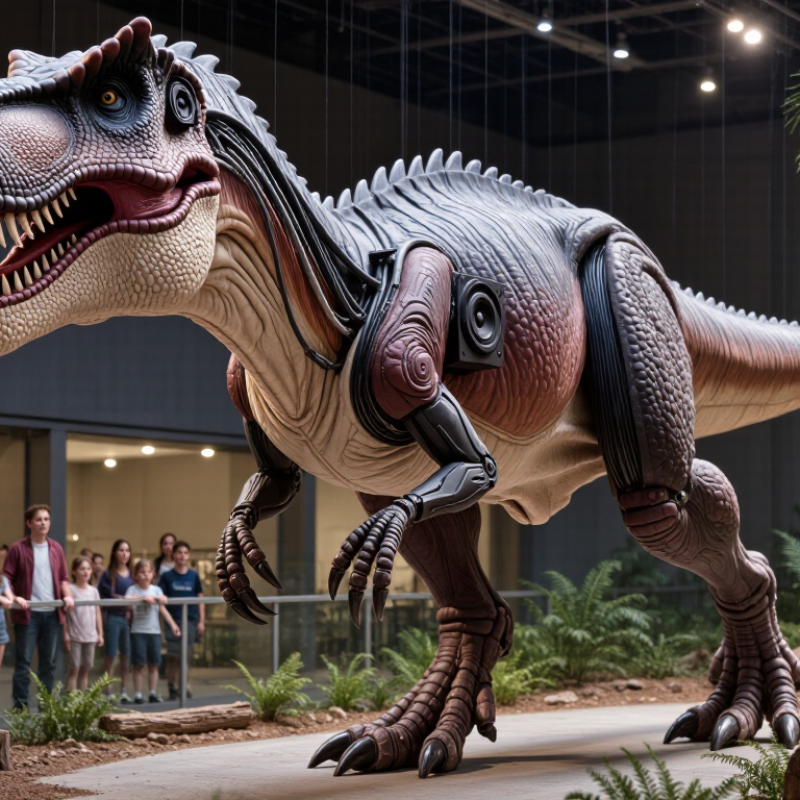
| Definition | Human-made robotic or mechanical models designed to imitate dinosaur appearance and movement. | Extinct reptiles and birds in the group Dinosauria that lived during the Mesozoic Era. |
| Time of Existence | Can be built and operated today or at any time after manufacturing. | Non-avian dinosaurs lived approximately 245–66 million years ago, from the Triassic through the end of the Cretaceous Period. |
| Energy Source | Usually electricity supplied by batteries, mains power, hydraulic systems, or compressed air. | Obtained biological energy from food through metabolism. |
| Movement | Movement is produced by programmed motors, actuators, hydraulics, cables, or mechanical joints. It may include head, jaw, tail, limb, or body motion. | Movement was controlled by muscles, bones, joints, nerves, and sensory systems. Exact movement patterns are reconstructed from fossils and living animal comparisons. |
| Growth and Development | Does not grow or reproduce. Its size is fixed when manufactured. | Grew from eggs or hatchlings into adults and changed physically throughout its life. |
| Skin and Outer Surface | Often covered with molded rubber, silicone, fiberglass, foam, fabric, or painted synthetic materials. | Had biological skin, scales, feathers, or other tissues. Fossils show that some dinosaur groups had feathers or feather-like coverings. |
| Sound | Uses recorded, synthesized, or electronically generated sounds. These sounds are artistic interpretations rather than confirmed dinosaur vocalizations. | Produced biological sounds, but the exact calls of most extinct dinosaurs are unknown. Fossils can provide limited clues about sound-producing anatomy. |
| Control System | May be controlled by software, sensors, timers, remote controls, or human operators. | Behavior was regulated by a living nervous system and influenced by instinct, learning, environment, and social interactions. |
| Size Range | Can be miniature, life-sized, or larger than life, depending on its design and intended use. | Varied greatly among species, from small bird-sized dinosaurs to giant sauropods measuring more than 30 meters in length. |
| Reproduction | Cannot reproduce; new units must be designed and manufactured. | Dinosaurs reproduced biologically, and fossil evidence shows that many laid eggs in nests. |
| Maintenance | Requires inspection, cleaning, software or control adjustments, battery replacement, and mechanical repairs. | Maintained its body through biological processes such as healing, feeding, and tissue replacement, although it could suffer injury and disease. |
| Movement Speed | Usually limited by motor power, stability, safety requirements, and programming. A display model may move more slowly than a living animal. | Varied by species, body design, size, and behavior. Scientific estimates are based on fossils, biomechanics, trackways, and comparisons with living animals. |
| Scientific Evidence | Represents an educational or entertainment reconstruction and may combine fossil evidence with artistic choices. | Known through fossils such as bones, teeth, footprints, nests, eggs, feathers, skin impressions, and coprolites. |
| Main Purpose | Used for education, exhibitions, film production, themed attractions, research demonstrations, and entertainment. | Lived as part of ancient ecosystems and interacted with other organisms and environmental conditions. |
| Key Limitation | Cannot fully reproduce the biology, behavior, senses, flexibility, or unpredictability of a living dinosaur. | No living non-avian dinosaur can be directly observed today, so many details must be inferred from scientific evidence. |


 Your message must be between 20-3,000 characters!