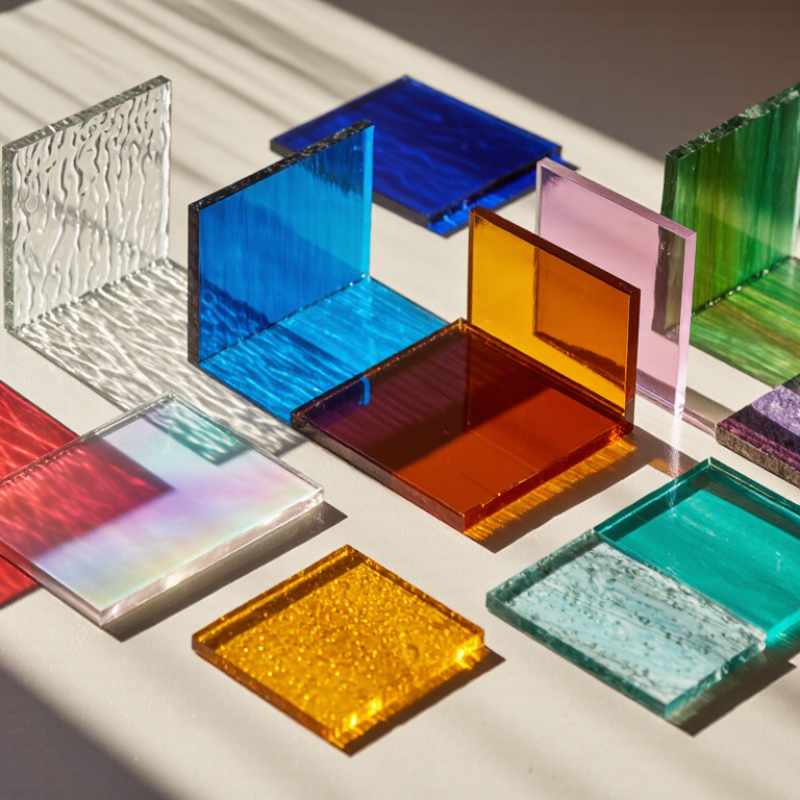
| Cathedral | Transparent, usually colored throughout; allows strong light transmission. | Window panels, sun catchers, lamps, and designs that rely on clear color. | Check color consistency, surface uniformity, and how the glass looks against the intended light source. | Useful where daylight or backlighting is important. Confirm color appearance with a physical sample, since lighting conditions affect perceived color. |
| Opalescent | Opaque or partly translucent, often with cloudy or marbled color variations. | Decorative panels, lettering, floral motifs, and projects needing less see-through glass. | Review opacity, color distribution, and whether the sheet has enough contrast for the design. | May transmit less light than transparent glass. Ask for current-batch images or samples when matching a repeat order. |
| Wispy | Colored streaks or wisps run through a contrasting or lighter base. | Leaves, skies, water, landscapes, and other organic design details. | Check streak direction, scale, and distribution; cutting orientation can change the visual result. | Allow for natural variation between sheets. Buyers ordering multiple sheets should clarify whether matching patterns are available. |
| Streaky | Visible bands or linear color variation create a directional appearance. | Architectural accents, borders, abstract panels, and designs with directional movement. | Inspect the direction and width of the streaks and plan cut layouts before ordering. | Confirm that the available sheet dimensions suit the planned layout and reduce unnecessary offcuts. |
| Waterglass | Textured surface with irregular, flowing distortions that scatter and refract light. | Windows, lamps, privacy accents, and panels where surface movement is desired. | Assess texture depth, usable flat areas, and how the surface changes the view through the glass. | Texture can affect handling and appearance in finished work. Request details about which face is textured and how sheets are protected in transit. |
| Ripple | Repeating wave-like surface texture produces a flowing light effect. | Decorative windows, lampshades, borders, and water-inspired designs. | Check ripple direction, spacing, and how the pattern aligns with the intended cut shapes. | Consider orientation during fabrication and packing. Confirm that the texture is suitable for the project's cleaning and maintenance needs. |
| Granite | Fine, mottled texture gives the surface a stone-like visual effect. | Background areas, geometric panels, borders, and designs needing subtle texture. | Compare the pattern scale and color density with the surrounding glass pieces. | Useful for combining visual texture with a less directional pattern. Review a sample if a consistent appearance across several sheets is important. |
| Seedy | Small bubbles or seed-like inclusions are visible within the glass. | Traditional-style panels, antique-inspired designs, and decorative accents. | Check bubble distribution and size; confirm that the appearance suits the desired finish. | Inclusions are part of the visual character and can vary. Confirm the maker's stated quality criteria if uniformity is required. |
| Hammered | Irregular, dimpled surface texture diffuses light and softens views. | Privacy screens, cabinet inserts, lamps, and textured decorative panels. | Evaluate the degree of distortion, surface relief, and suitability for the design's fitting method. | Check both sides and the texture profile before specifying the glass for a project that requires a particular outward-facing surface. |
| Iridescent | Surface coating creates shifting color highlights that change with angle and lighting. | Accents, jewelry components, decorative panels, and focal pieces. | Inspect coating coverage, color shift, and the side on which the finish is applied. | Ask about handling and cleaning recommendations for the surface finish. Verify suitability for the intended fabrication process before ordering. |


 Your message must be between 20-3,000 characters!