| Product safety compliance | Confirm that the exact mat design, material, color, and intended age group have been assessed against the regulations for the destination market. | Recent test reports from a competent laboratory; report details should match the product and materials being ordered. For the United States, check applicable CPSIA requirements and the current ASTM F963 requirements. For the European Union, check applicable toy-safety requirements, including relevant EN 71 tests. | Children’s product requirements depend on destination, product classification, and intended use. A general certificate or a report for a different product is not sufficient evidence. |
| Chemical testing and material control | Ask how foam, surface films, inks, adhesives, and printed coatings are identified and controlled. Check which restricted substances are tested for the target market. | Product-specific laboratory reports. EN 71-3 addresses migration of certain elements from toy materials; it does not cover every chemical hazard. For US sales, confirm applicable lead and restricted-phthalate requirements under CPSIA. | Printed patterns and layered construction can introduce materials that are not represented by testing of the foam alone. |
| Material and construction transparency | Verify the stated foam type, layer structure, surface film, dimensions, and thickness against the production specification. | Material declaration, approved product specification, pre-production sample, and an inspection record measuring finished dimensions and thickness. | Clear specifications make supplier quotations comparable and help prevent unapproved substitutions. |
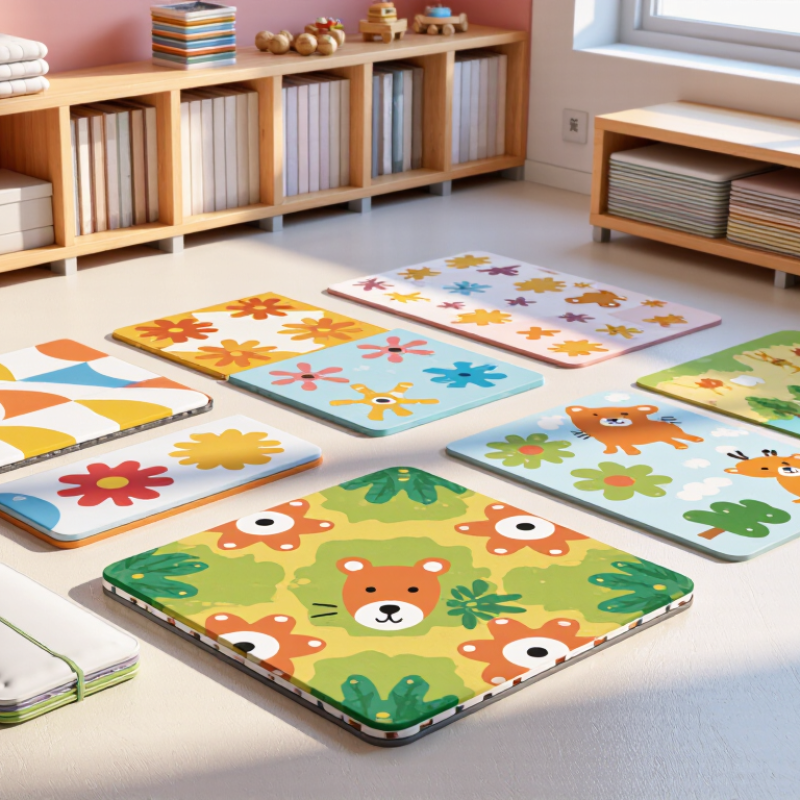
| Pattern print quality | Assess print alignment, color consistency, edge coverage, surface defects, and whether the design remains legible after normal handling. | Signed-off artwork proof and production sample; documented visual inspection under consistent lighting; agreed limits for color and print-position variation. | A controlled approval process reduces the risk of receiving mats with visibly inconsistent or misaligned patterns. |
| Durability and workmanship | Check seams or puzzle-piece edges, delamination, surface peeling, odor, and resistance to routine cleaning as relevant to the design. | Written quality criteria, sample evaluation, and inspection results using agreed methods. Request the test method and acceptance limits rather than relying on unsupported claims. | Durability depends on the material stack and intended use; buyers should define measurable acceptance criteria before production. |
| Quality-management controls | Review incoming-material checks, production inspections, finished-goods sampling, defect handling, and traceability procedures. | Factory audit records, inspection plans, corrective-action records, and lot or batch identification. ISO 9001 certification, if claimed, should be checked for scope and validity. | Quality systems support consistent production, but certification alone does not prove that a specific play mat is safe or compliant. |
| Production capacity and lead time | Confirm available production capacity, order minimums, sample timing, production lead time, and peak-season planning. | A written production schedule tied to the agreed order quantity, artwork approval date, material availability, and inspection milestones. | Capacity and lead times vary by product construction and season; written commitments are more useful than general claims. |
| Packaging and shipping readiness | Check whether packaging protects the mat from moisture, dirt, compression, and transit damage, and whether required labels are included. | Approved packaging sample, carton specifications, packing list, and destination-market labeling review. | Packaging and labeling requirements vary by market and sales channel, so they should be confirmed before mass production. |
| Supplier verification | Confirm the contracting entity, production address, business scope, and whether manufacturing is performed in-house or subcontracted. | Business registration documents, facility details, a live factory review or independent audit, and written disclosure of subcontracting. | Verifying the actual production site helps buyers assess oversight, traceability, and accountability. |
| How to compare suppliers | Use the same product specification and destination-market checklist for every candidate. Treat the criteria above as a due-diligence framework, not as claims about any particular manufacturer; verify all certificates, test reports, capabilities, and lead times directly before placing an order. |


 Your message must be between 20-3,000 characters!