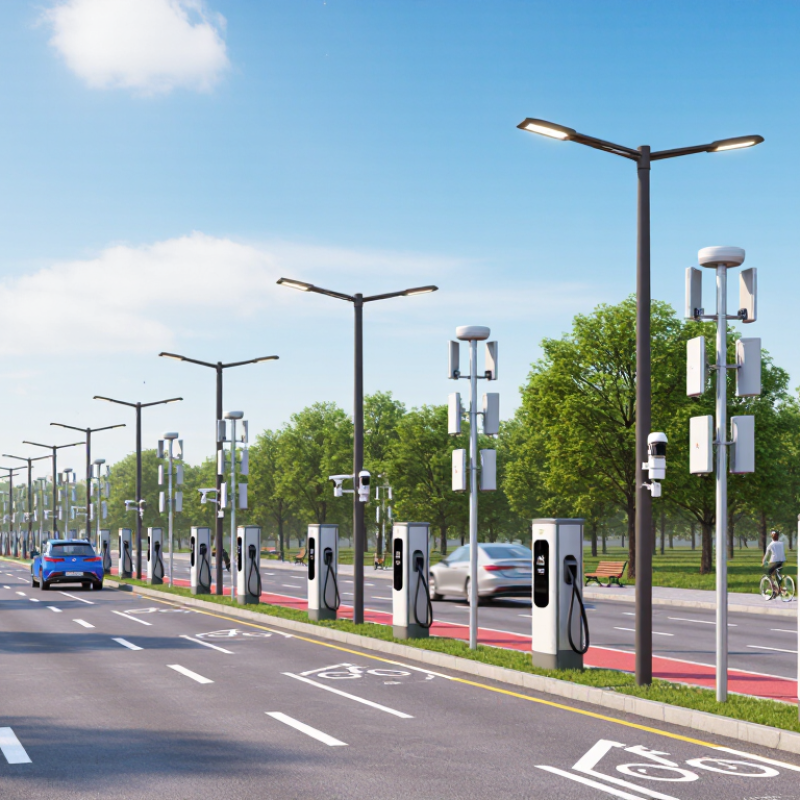
| FR1 wide-area coverage pole | FR1: 410 MHz–7.125 GHz | n28: 703–803 MHz; n78: 3.3–3.8 GHz | FR1 radio equipment connected to pole-mounted panel or compact antenna systems. | Lower FR1 frequencies generally provide broader coverage and better building penetration than FR2, subject to frequency, terrain, antenna, and deployment conditions. | Road corridors, residential areas, and sites needing broad outdoor coverage. | Check local spectrum allocation, antenna separation, radio power, structural loading, and access for maintenance. |
| FR1 capacity-focused street pole | FR1: 410 MHz–7.125 GHz | n77: 3.3–4.2 GHz; n78: 3.3–3.8 GHz | Compact mid-band radio with a multi-element antenna; configuration depends on the network and local regulations. | Mid-band spectrum can provide more capacity than many lower-frequency deployments, while generally covering less distance than lower-band FR1. | Busy streets, transit stops, and mixed-use districts where coverage and capacity are both required. | Actual bandwidth and performance depend on the licensed channel, network configuration, interference, and surrounding clutter. |
| FR1 + FR2 layered-coverage pole | FR1: 410 MHz–7.125 GHz; FR2-1: 24.25–52.6 GHz; FR2-2: 52.6–71 GHz | FR1 examples: n28, n78. FR2-1 examples: n258 (24.25–27.5 GHz), n257 (26.5–29.5 GHz). | Separate FR1 and FR2 radio/antenna systems on one pole, where supported by the network design. | FR1 can provide a wider-area coverage layer; FR2 can add localized capacity. FR2 links are more sensitive to blockage and typically serve smaller areas. | High-demand urban locations where broad-area service and targeted hotspot capacity are both needed. | Plan for antenna placement, mutual interference, power and fiber availability, cooling, wind loading, and safe servicing. |
| FR2 millimeter-wave small-cell pole | FR2-1: 24.25–52.6 GHz; FR2-2: 52.6–71 GHz | n257: 26.5–29.5 GHz; n258: 24.25–27.5 GHz; n260: 37–40 GHz | Compact FR2 radio with an integrated or closely coupled directional antenna array. | Can support high-capacity, localized coverage where suitable spectrum and equipment are deployed; range and reliability are affected by blockage and propagation conditions. | Dense public spaces, venues, transport hubs, and other targeted hotspots. | Carefully assess line of sight, mounting direction, nearby obstructions, site density, backhaul, and country-specific band availability. |
| FR2-2 higher-frequency hotspot pole | FR2-2: 52.6–71 GHz | 3GPP FR2-2 frequency range; specific NR band support and commercial availability depend on the applicable specification release and market. | Purpose-designed FR2 radio and antenna hardware matched to the selected NR band. | Higher-frequency links require careful attention to path loss, blockage, and propagation; deployment suitability is highly site- and equipment-dependent. | Specialized, short-range capacity zones where compatible spectrum and equipment are available. | Verify supported NR bands, local authorization, device ecosystem, link budget, and environmental performance before selection. |


 Your message must be between 20-3,000 characters!