| Wind turbine blade reinforcement | Spar caps and other load-bearing blade sections, particularly in large offshore turbines. | Longer blades capture more wind, while carbon fiber can help reduce structural mass and improve stiffness. Blades in the largest designs can exceed 100 m; carbon fiber is generally used in selected structural areas, not necessarily throughout the entire blade. | Unidirectional carbon fiber fabrics, pultruded laminates, and carbon fiber prepreg. | Check fiber and resin compatibility, fatigue performance, process requirements, quality consistency, and suitability for the blade design. |
| Hydrogen and compressed-gas pressure vessels | Type IV hydrogen storage tanks and other composite-overwrapped pressure vessels. | Hydrogen mobility and industrial gas storage require lightweight vessels designed to contain gas at high pressure. | Filament-wound carbon fiber over a polymer liner. | Review applicable pressure-vessel regulations, design pressure, fatigue-cycle requirements, traceability, and qualification documentation. |
| Aerospace structures | Aircraft interior and structural components, control surfaces, and satellite structures. | Weight reduction can improve aircraft efficiency and payload capacity; aerospace programs also value high specific stiffness and strength. | Prepreg, woven fabric, and unidirectional tape used in engineered laminates. | Confirm material specifications, batch traceability, process controls, testing data, and program-specific approval requirements. |
| Automotive components | Body panels, structural parts, drive shafts, and selected performance-vehicle components. | Vehicle lightweighting and performance targets support demand, while material and processing costs influence where carbon fiber is practical. | Prepreg, woven fabrics, chopped-fiber compounds, and continuous-fiber laminates. | Compare production rate, tooling and curing needs, repairability, surface finish, and total part cost. |
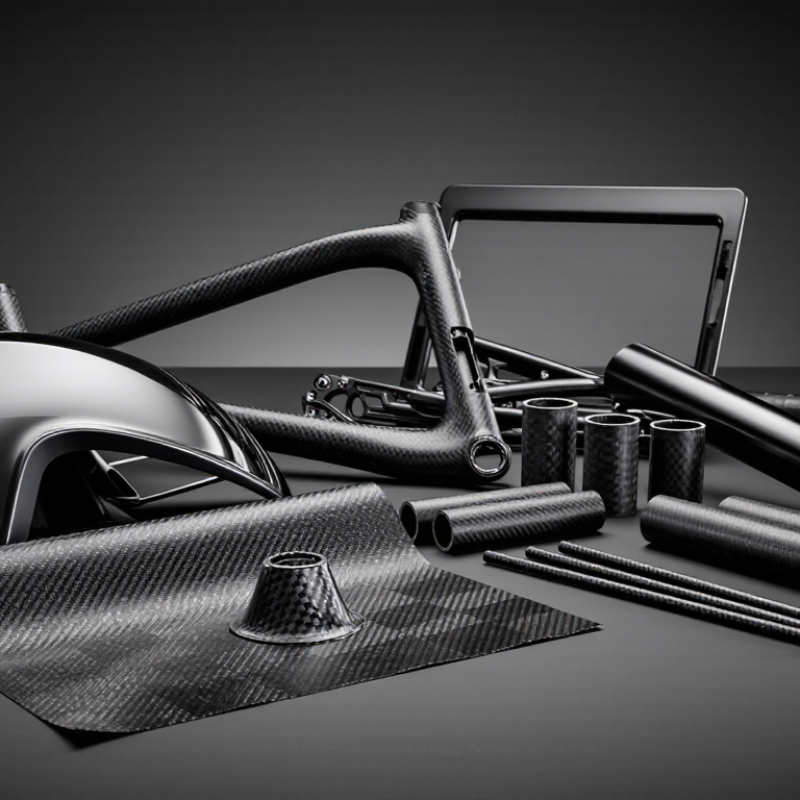
| Bicycle and sporting-goods components | Bicycle frames and forks, tennis racquets, fishing rods, and other lightweight equipment. | Buyers seek low mass, stiffness, and the ability to tailor product performance through laminate design. | Unidirectional and woven prepreg; tube and molded composite constructions. | Assess impact resistance, fatigue behavior, layup consistency, finish requirements, and product-specific testing. |
| Marine components | Yacht masts, spars, foils, and selected hull or deck structures. | Weight savings and high stiffness can benefit sailing and performance craft; composite materials also avoid metal corrosion. | Prepreg, woven fabrics, unidirectional reinforcement, and pultruded profiles. | Check moisture protection, UV-resistant surface systems, fatigue performance, joining methods, and repair procedures. |
| Building and infrastructure strengthening | External reinforcement of concrete beams, columns, slabs, and some masonry structures. | Retrofitting can increase structural capacity or support repairs without adding substantial weight or bulk. | Carbon fiber reinforced polymer (CFRP) sheets, fabrics, and laminates bonded with resin. | Verify design guidance and local approvals, substrate condition, adhesive system, installation controls, and fire-protection requirements. |
| Industrial rollers and machine components | Lightweight rollers, shafts, and rotating or moving machine parts. | Lower component mass can reduce inertia in suitable applications, while high stiffness helps control deflection. | Filament-wound or pultruded tubes and custom composite laminates. | Specify dimensions, load and speed conditions, balance, surface finish, bearing interfaces, and operating environment. |
| Drone and unmanned-aircraft structures | Frames, arms, fuselage sections, and wings for unmanned aircraft. | Low mass and structural stiffness can support payload, endurance, and flight-performance objectives. | Woven fabric, prepreg, molded laminates, and composite tubes. | Consider impact tolerance, vibration behavior, antenna or sensor integration, repairability, and manufacturing repeatability. |
| Prosthetic and orthotic components | Prosthetic blades, foot components, and selected orthotic supports. | Lightweight structures with tailored stiffness can support mobility and user-specific performance needs. | Carbon fiber fabric and unidirectional laminates formed with resin systems. | Assess fit and customization needs, fatigue testing, surface comfort, repair options, and applicable medical-device requirements. |


 Your message must be between 20-3,000 characters!