Leave a Message
We will call you back soon!
Your message must be between 20-3,000 characters!
Please check your E-mail!
More information facilitates better communication.
Submitted successfully!
We will call you back soon!
Leave a Message
We will call you back soon!
Your message must be between 20-3,000 characters!
Please check your E-mail!
Choosing among the top Bunk Bed Frame manufacturers in China requires more than comparing catalog prices. A dependable supplier should demonstrate manufacturing experience, stable material sourcing, and clear quality procedures. This guide examines factories that produce the Bunk Bed Frame for homes, dormitories, hostels, and contract furniture projects.
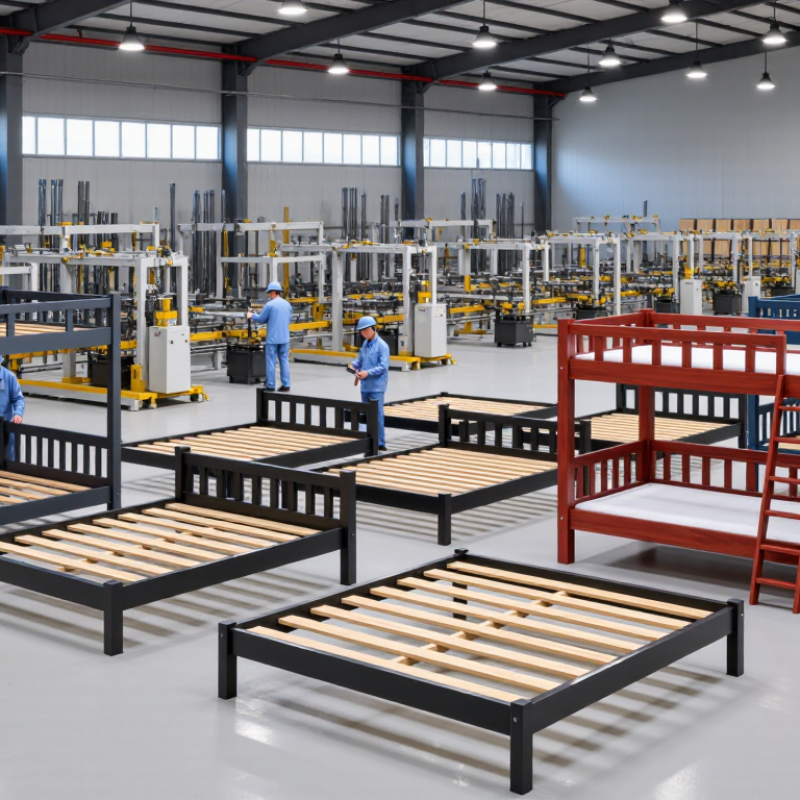
Strong manufacturers usually provide steel or solid-wood specifications, welding details, surface-finish options, and accurate dimensional drawings. Look for evidence of load testing, guardrail strength, ladder stability, and mattress-support performance. Factory visits can reveal practical details that online photographs hide, including uneven welds, crowded production lines, or inconsistent powder coating. These small observations matter.
Documentation also deserves careful review. Ask for inspection records, material certificates, production samples, and traceable quality-control steps. Suppliers familiar with international markets should explain applicable safety requirements without making vague promises. Certifications can support credibility, but they should match the actual product and current production site. A certificate alone proves little.
No manufacturer is perfect. Some factories offer excellent engineering but limited customization. Others provide attractive designs yet communicate slowly after payment. Lead times may change during peak seasons, and sample quality may not represent every production batch. That uncertainty deserves attention. By comparing factory capability, testing discipline, communication, and after-sales support, buyers can build a more reliable shortlist. The goal is not simply to find the lowest quotation. It is to identify a Chinese partner capable of producing safe, durable, and consistently documented bunk bed frames.
China remains a leading bunk bed frame manufacturing hub because its supply chain is unusually complete. The CSIL World Furniture Outlook 2024 estimates that China produces about 37% of global furniture output. This scale supports competitive steel, timber, hardware, coating, packaging, and logistics networks. A factory can often source welded tubes, powder coating, ladder components, and cartons within one industrial region. That reduces transport time and simplifies production planning.
UN Comtrade data also shows China as a major exporter of furniture and related parts. The broader furniture category exceeded 70 billion US dollars in annual exports during recent reporting years. Bunk bed frames benefit from this export infrastructure, especially for flat-packed products. CNC cutting improves hole alignment. Robotic welding can strengthen repeated joints. Manual sanding still matters at contact points. Small details matter.
Quality is not automatic. Some workshops still depend heavily on manual inspection, which can create uneven weld finishing or coating thickness. Experienced buyers should request load testing, dimensional checks, corrosion testing, and packaging-drop records. EN 747 testing is often used as a practical reference for bunk bed safety, although destination-market requirements may differ. China’s advantage is its manufacturing depth, not perfection. The strongest suppliers combine engineering control with visible, repeatable inspection records.
Chinese manufacturers produce several bunk bed frame types for different room sizes, ages, and price levels. The standard twin-over-twin frame remains common because it fits narrow bedrooms and uses simple ladder geometry. Twin-over-full models provide a wider lower berth for teenagers or adults. Loft frames remove the lower bed and create space for a desk, drawers, or a compact wardrobe. Triple-stack designs increase capacity, but they require stricter attention to ceiling height and access safety.
Materials also divide the market. Powder-coated steel frames offer slim posts, repeatable welding, and easier flat-pack shipping. Solid-wood frames feel warmer and usually resist vibration better, although moisture control becomes important. Convertible frames can separate into two single beds. Useful, but hinges and fasteners need careful inspection. A 2024 market outlook from Grand View Research projects steady growth in the global bunk bed sector through 2030, while Statista’s furniture data continues to identify China as a major production and export base. These figures support demand, not automatic quality.
Experienced Chinese factories often combine these formats with reinforced center rails, anti-slip ladder steps, guardrails, and tested load points. Buyers should request test reports, material specifications, weld inspection records, and assembly instructions. EN 747 and ASTM F1427 are useful reference standards for dimensional and safety checks. Some catalog photographs look convincing. They prove very little. A practical audit should measure guardrail height, check bolt access, and apply repeated-load testing before shipment. Even then, design assumptions can fail in real homes, especially when users climb, swing, or modify the frame.
| Bunk Bed Frame Type | Typical Mattress Sizes | Common Frame Materials | Structural Features | Typical Applications | Main Advantages | Important Considerations |
|---|---|---|---|---|---|---|
| Twin-over-Twin Bunk Bed | Approximately 75 × 38 in (190 × 97 cm) | Steel, solid wood, engineered wood, or mixed materials | Two single-size sleeping platforms arranged vertically, usually connected by guardrails, a ladder, and support slats. | Children’s bedrooms, dormitories, hostels, camps, and compact guest rooms. | Efficient use of floor space and a simple, widely compatible layout. | Check upper-bunk weight capacity, guardrail height, ladder security, and ceiling clearance. |
| Twin-over-Full Bunk Bed | Upper: approximately 75 × 38 in Lower: approximately 75 × 54 in | Powder-coated steel, solid wood, plywood, or engineered wood | A narrower upper bunk is positioned above a wider lower bunk, with reinforced lower-bed supports. | Shared bedrooms, family homes, vacation rentals, and rooms used by children of different ages. | Provides a larger lower sleeping surface while retaining vertical space efficiency. | The wider lower frame requires stronger cross-supports and more floor clearance than a twin-over-twin model. |
| Full-over-Full Bunk Bed | Approximately 75 × 54 in (190 × 137 cm) | Steel or solid wood, often with reinforced joints and center supports | Two full-size sleeping platforms stacked vertically, commonly supplied with full-length guardrails on the upper level. | Teen bedrooms, guest accommodations, rental properties, and shared rooms requiring generous sleeping space. | Offers more width for each sleeper than twin-size configurations. | It is heavier and wider; room dimensions, stair or doorway access, and floor loading should be reviewed. |
| Triple Bunk Bed | Usually twin-size; some designs combine twin and full sizes | Steel tubing, solid wood, or reinforced composite panels | Three sleeping levels or two stacked beds with an additional pull-out or integrated lower berth. | Large families, dormitories, camps, worker accommodations, and high-occupancy rooms. | Maximizes sleeping capacity within a limited floor area. | Requires careful assessment of ceiling height, access to each level, guardrails, ventilation, and total load capacity. |
| Loft Bunk Bed | Commonly twin-size; full-size versions are also available | Powder-coated steel, solid wood, or engineered wood | The elevated bed leaves open space underneath for a desk, seating area, storage, or an additional bed. | Children’s rooms, student housing, studio apartments, and compact bedrooms. | Creates a multifunctional zone without substantially increasing the bed’s footprint. | Verify the working height beneath the loft, upper guardrail coverage, ladder placement, and stability of the base. |
| L-Shaped Bunk Bed | Usually twin-over-twin or twin-over-full | Solid wood, engineered wood, steel, or hybrid construction | Two sleeping platforms meet at a right angle, often creating storage space or an open corner below the upper bunk. | Shared children’s rooms, corner installations, and rooms needing additional storage options. | Offers improved separation between sleepers and can use corner space effectively. | Its footprint is wider than a straight bunk bed; confirm the orientation, ladder position, and available wall space. |
| Convertible Bunk Bed | Typically twin-over-twin or twin-over-full | Solid wood, engineered wood, steel, or a combination of materials | Designed to separate into two independent beds or convert between bunk and non-bunk configurations. | Growing families, guest rooms, rental properties, and flexible-use bedrooms. | Provides long-term adaptability as room needs or user ages change. | Conversion hardware, connector alignment, and independent-bed stability should be checked before purchase. |
| Bunk Bed with Trundle | Upper and lower beds are commonly twin-size; trundle is usually twin-size | Steel, solid wood, engineered wood, or mixed construction | Includes a low-profile pull-out bed beneath the lower bunk, sometimes with drawers or storage compartments. | Children’s rooms, sleepovers, guest rooms, and compact hospitality spaces. | Adds an occasional sleeping surface while keeping the trundle concealed when not in use. | Allow clearance for the pull-out mechanism and confirm that the floor is level enough for smooth operation. |
| Metal Bunk Bed | Most commonly twin-size; full-size options are also produced | Powder-coated steel or other finished metal tubing | Welded or bolted metal rails, metal slats, guardrails, and ladder components. | Dormitories, hostels, military-style accommodation, camps, and institutional housing. | Generally durable, easy to clean, and suitable for high-use environments. | Inspect weld quality, coating durability, joint fasteners, noise control, corrosion resistance, and load ratings. |
| Wooden Bunk Bed | Commonly twin, twin-over-full, or full-size combinations | Solid pine, rubberwood, beech, plywood, or engineered wood | Wooden posts, rails, slats, guardrails, and ladders with visible or concealed fastening systems. | Residential bedrooms, boutique accommodation, vacation homes, and children’s furniture collections. | Warm appearance, broad design flexibility, and compatibility with painted or stained finishes. | Review wood moisture control, joint strength, surface finish, splinter prevention, and long-term fastener maintenance. |

Evaluating a bunk bed frame manufacturer requires more than comparing prices. Start by checking factory experience, production capacity, and product records. Ask how long the factory has made metal or solid wood frames. Request photos of welding stations, drilling equipment, and finished inspection areas. A serious supplier should explain material grades, tube thickness, joint design, and surface treatment clearly. Avoid vague answers.
Ask for evidence. Details reveal discipline.
Request samples before placing a large order. Inspect ladder steps, guardrail height, corner finishing, fasteners, and mattress support spacing. Shake the assembled frame gently. It should feel stable, not merely attractive. Review load-testing procedures and inspection reports from qualified laboratories when available. Confirm that testing reflects the intended market’s safety requirements. One successful sample does not prove consistent production. That is an easy mistake.
Reliable manufacturers also control what happens after production. Check batch records, packaging methods, spare-part availability, and corrective-action reports. Ask how defects are handled and how quickly replacements are supplied. A factory may have modern machinery but weak communication. That weakness can become costly. Visit the facility, or use an independent inspection service before shipment. I would also compare repeated samples from different batches. No manufacturer is flawless. The more important question is whether the team identifies problems honestly and fixes them with documented actions.
Top Bunk Bed Frame Manufacturers in China
Reliable bunk bed frame manufacturers in China treat safety as a production process, not a marketing phrase. Their factories should follow applicable Chinese GB standards and destination-market requirements, such as EN 747 or ASTM F1427. Current editions matter. A printed certificate alone is not enough. Auditors should verify test reports, material records, welding procedures, and production samples.
Steel frames commonly use powder-coated carbon steel tubing for strength and consistent dimensions. Solid wood frames require controlled moisture levels to reduce cracking and movement. Plywood platforms should have stable layers and clean edges. Coatings must resist peeling, especially around ladders and guardrails. Good factories inspect tube thickness, weld penetration, bolt torque, and surface finish. Small defects can become serious during repeated use.
Safety details deserve direct measurement. The upper bunk needs secure guardrails on exposed sides. Ladder rungs should resist slipping and remain firmly attached. Gaps must be checked for head, neck, and limb entrapment risks. Load testing should include the frame, slats, fasteners, and guardrail system together. Mattress supports must prevent excessive movement, while the structure should resist shaking and tipping. Wall anchoring instructions need clear diagrams and suitable hardware guidance. Many inspections focus on appearance first. That is a mistake. Packaging damage, missing washers, or unclear assembly steps can also create hazards. Factories should record corrective actions, even when the problem seems minor.
Minimum upper-bunk guardrail heights specified by selected international safety requirements. These benchmarks are useful when evaluating Chinese manufacturers, material choices, welding quality, and final product inspection procedures.
EN 747 requires a minimum 260 mm guardrail height above the mattress surface, while U.S. 16 CFR Part 1213 requires at least 127 mm above the mattress. Actual compliance also depends on mattress thickness, openings, structural strength, labeling, and testing. Common production materials include powder-coated steel tube, solid wood, and engineered wood panels.
Reliable sourcing begins with factory verification, not attractive catalog photos. Ask for production videos, export experience, and clear material specifications. Confirm whether the manufacturer controls cutting, welding, coating, and packing in-house. A factory visit can reveal practical details, such as crowded aisles or inconsistent storage. These details matter. Request steel grades, tube thickness, surface treatment, and hardware lists before ordering samples. A polished sample can still hide weak internal processes.
Customization should cover dimensions, ladder position, guardrail height, color, packaging, and assembly instructions. Share technical drawings with tolerances, not only reference images. During quality control, inspect weld penetration, sharp edges, coating adhesion, hole alignment, and mattress support spacing. Load testing should match the intended market and usage conditions. Ask for dated test records and traceable batch numbers. In my experience, suppliers sometimes promise tighter tolerances than they can maintain. Small revisions may be necessary.
Tips: Approve a golden sample before mass production. Use an independent inspection before shipment. Photograph hidden joints and packed components. Check cartons for crushed corners and missing screws. Keep written approval records. Do not rely on verbal assurances. A slightly slower inspection often prevents expensive rework.