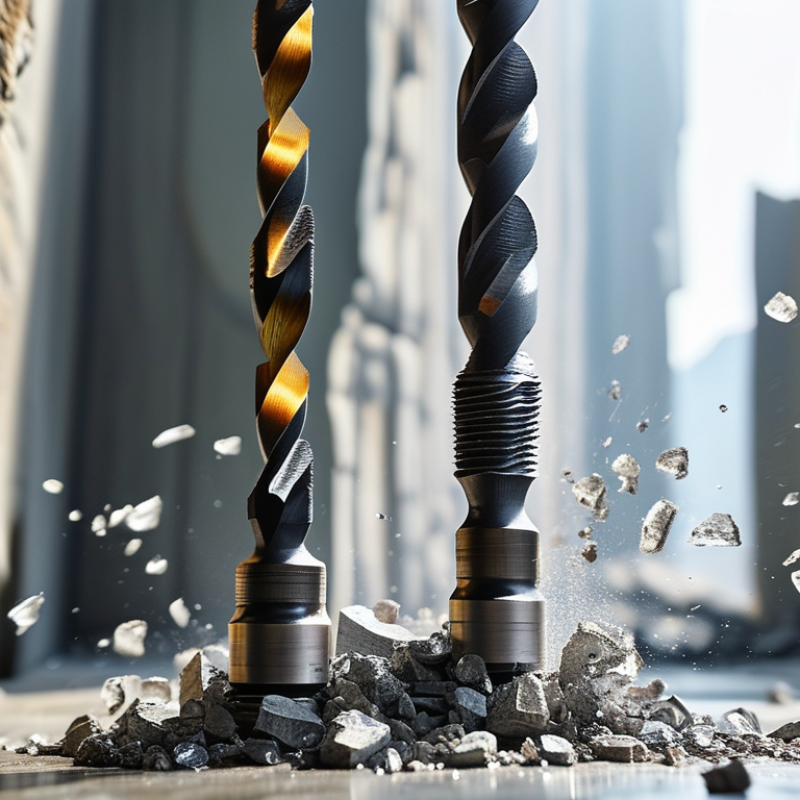
| Carbide Cross Bit | Soft to medium rock, fractured formations, small-scale construction, and general-purpose drilling. | Handheld or light pneumatic drilling; rotary-percussive operation. | Approximately 25–50 mm | Simple design, low initial cost, reliable in variable or broken ground, and easy to resharpen in some configurations. | Lower penetration efficiency in very hard, abrasive rock; cross edges can wear unevenly. | Choose when portability, low cost, and moderate drilling accuracy are more important than maximum output. |
| Carbide Button Bit | Medium-hard to hard rock, quarrying, bench drilling, foundation work, and production drilling. | Top-hammer rotary-percussive drilling. | Approximately 28–152 mm | Good impact resistance, consistent hole formation, and multiple button profiles for different rock conditions. | Requires correct rotation speed, feed force, and flushing; buttons may chip in highly fractured ground. | Prioritize rock hardness, abrasiveness, button shape, gauge protection, and equipment compatibility. |
| DTH Hammer Bit | Hard, competent rock; water wells, geotechnical drilling, blasting, and deep holes requiring straightness. | Down-the-hole hammer drilling with the hammer operating at the bit. | Approximately 90–305 mm | Efficient energy transfer at depth, good hole straightness, and stable performance in hard formations. | Needs adequate compressor capacity and air volume; drilling performance can decline in unstable or highly fractured formations. | Match bit diameter, hammer size, shank connection, air pressure, and required hole depth. |
| Tricone Roller-Cone Bit | Soft to hard formations in larger-diameter blast holes, mining, construction, and selected oilfield applications. | Rotary drilling, with crushing and gouging action from rolling cones. | Approximately 89–660 mm | Broad formation range, effective in large holes, and available with different tooth or insert designs. | Moving parts require careful maintenance; unsuitable operating parameters can accelerate bearing and cutter wear. | Select according to formation strength, abrasiveness, hole diameter, rotary torque, and required weight on bit. |
| PDC Bit | Soft to medium-hard, relatively homogeneous formations with limited impact loading. | Continuous rotary drilling using fixed polycrystalline diamond cutters. | Approximately 76–444 mm | High cutting efficiency, smooth drilling action, and potentially long service life in suitable formations. | Sensitive to severe impacts, hard stringers, large fractures, and excessive vibration. | Use when the formation is compatible with fixed-cutter technology and rotary efficiency is a primary goal. |
| Diamond Core Bit | Geological exploration, mineral sampling, concrete coring, and applications requiring an intact cylindrical core. | Rotary core drilling with water or another suitable flushing medium. | Approximately 27–250 mm | Produces representative core samples and can drill hard rock with controlled cutting action. | Generally slower than production drilling; requires careful control of rotation, feed, and cooling. | Match diamond type, matrix hardness, core size, rock abrasiveness, and flushing conditions. |


 Your message must be between 20-3,000 characters!