How to Choose the Right Light Pole for Global Projects?
Choosing the right Light Pole for global projects is not simply a matter of height, price, or appearance. It is a risk decision involving wind pressure, soil conditions, corrosion, lighting performance, transport, and maintenance access. A 12-meter steel pole may suit a coastal highway, yet fail quickly without the correct coating and foundation design. Local standards matter too. EN 40, AASHTO specifications, IEC requirements, and regional wind codes may produce different design obligations.
Industry data shows why the decision deserves closer attention. The U.S. Department of Energy’s Adoption of LEDs in Common Lighting Applications report estimated that LEDs reached approximately 49% penetration in outdoor stationary applications by 2019. The International Energy Agency has also identified lighting as a major electricity-use category, near 15% of global electricity consumption. Better optics can reduce wasted light, but only when the Light Pole spacing, mounting height, and fixture distribution are properly calculated.
Performance comes first.
James R. Benya, PE, a respected lighting engineer, once stated, “The best lighting is the least amount of light needed to do the job.” That principle should guide every international specification. Select the pole after reviewing photometric layouts, wind maps, foundation surveys, access equipment, and expected service life. It sounds obvious. It is often missed.
A reliable global approach also compares galvanized steel, aluminum, and composite materials under real site conditions. Salt spray, dust, vibration, theft exposure, and replacement logistics can change the final choice. No design is perfect. Even a well-written specification can overlook local soil behavior or delivery limits. Engineers should test assumptions early, document them clearly, and leave room for practical correction.
Define Project Requirements and Site Conditions
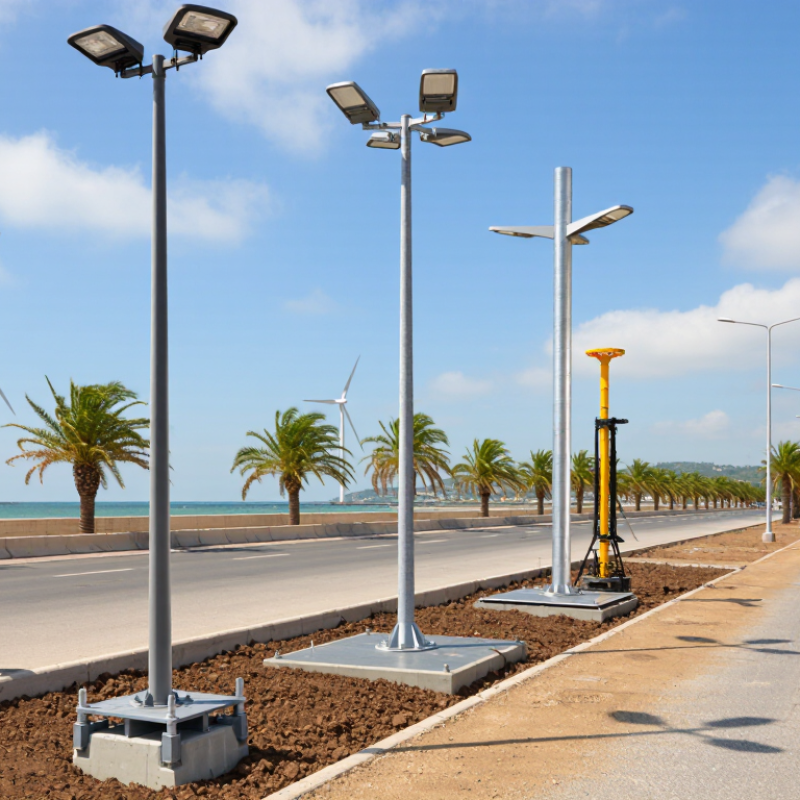
Choosing the right light pole begins long before a product specification is requested. Define the project’s purpose, lighting class, mounting height, outreach, and expected service life. A coastal road may require stronger corrosion protection than an inland parking area. A narrow street may need shorter outreach to control glare and protect nearby windows. Record traffic patterns, pedestrian movement, maintenance access, and future expansion plans. Small omissions become expensive changes later.
Site conditions decide whether a design remains safe after installation. Check wind speed, terrain exposure, soil bearing capacity, frost depth, drainage, and seismic risk. Confirm foundation dimensions through a qualified local engineer, not a distant assumption. Measure underground utilities before excavation. In my project reviews, drawings often look complete until soil reports reveal weak fill or a high water table. That uncomfortable discovery is useful. It prevents a visually neat solution from becoming a structural problem.
Tips: Create a site data sheet with coordinates, elevation, wind basis, soil results, fixture weight, and cable entry details. Photograph foundations, access roads, and nearby obstructions. Ask local contractors what equipment can actually reach the site. Keep a reasonable safety margin, but avoid adding steel without calculation. It increases cost and may complicate transport. Recheck lighting targets after pole spacing changes. One overlooked tree can create a dark zone. Document every assumption, including uncertain data, so reviewers can challenge it before procurement.
How to Choose the Right Light Pole for Global Projects?
Define Project Requirements and Site Conditions
Road lighting classes indicate the maintained average luminance required for different traffic and road-risk conditions. Higher classes require stronger optical performance and may require taller or more robust poles, depending on pole spacing, wind loading, soil capacity, corrosion exposure, and local regulations. The values shown are based on the M-class luminance levels specified in EN 13201-2.
Select the Appropriate Light Pole Material and Structure
For global projects, light pole selection starts with climate, not appearance. Coastal air, desert dust, freezing rain, and tropical humidity attack materials differently. Hot-dip galvanized steel suits many highway and urban sites because its zinc coating protects exposed surfaces. However, damaged coatings around welds, doors, and base plates can become early corrosion points.
The World Steel Association reported 1.89 billion tonnes of crude steel production in 2023. Steel remains widely available and structurally predictable. Aluminum offers lower weight and strong corrosion resistance.
The International Aluminium Institute states that recycling aluminum can save up to 95% of the energy required for primary production. That advantage matters when transport distances are long. Still, aluminum poles may require thicker sections or careful connection design in high-wind zones.
Structure matters as much as material. Tapered, octagonal poles usually distribute wind stress efficiently and simplify manufacturing. Engineers should verify wind pressure, fatigue, foundation rotation, and anchor-bolt loading under AASHTO LRFD or EN 40 requirements. ISO 9223 corrosion categories also help match protection systems to local exposure.
A common mistake is choosing a pole from a similar-looking project without checking soil conditions. I have seen drawings overlook access-door orientation and maintenance clearance. Small omissions become expensive on site. Material calculations alone are not enough. Geological surveys, wind records, coating inspection, and installation quality should shape the final specification.
Match Pole Height, Strength, and Lighting Performance
Choosing a light pole starts with the lighting task, not a catalogue image. Pole height controls spacing, uniformity, glare, and maintenance access. CIE 115:2010 recommends selecting lighting classes from road speed, traffic, conflict areas, and pedestrian risk. A taller pole may cover more pavement, but poor optics can create dark patches. The neatest layout can still fail at eye level.
Strength must match the site’s real exposure. EN 40-3-1 assesses wind actions for lighting columns, while local structural rules may require additional checks for gusts, terrain, and equipment area. Account for luminaire weight, windage, vibration, door openings, and future accessories. Coastal salt, freeze-thaw cycles, and polluted air can shorten service life. Corrosion protection is not decoration. It is structural insurance, although specifications sometimes treat it too casually.
Tips: Ask for the design wind speed, terrain category, foundation reaction, and fatigue assumptions before approving height. Check the complete luminaire-and-pole combination, not the pole alone. Compare illuminance, uniformity, and glare against CIE 115 targets. The International Energy Agency reports that lighting uses about 15% of global electricity, so efficient optics and accurate aiming matter. Measure after installation; drawings rarely show tree growth, truck shadows, or unexpected reflections. Leave room for doubt. A field adjustment may improve performance more than another spreadsheet revision.
Compare Installation, Maintenance, and Lifecycle Costs
How to Choose the Right Light Pole for Global Projects?
A light pole should be judged by more than its purchase price. Installation costs can change sharply between regions. A heavy steel pole may need cranes, wider foundations, and extra transport permits. A lighter tapered pole can reduce handling time, but only when local wind and soil conditions support it. Engineers should review wind speed, salt exposure, seismic risk, and access limitations before approving the design.
Maintenance costs often begin with small details. Check whether technicians can reach the fixture safely without closing a major road. Inspect the coating, access door, fasteners, and cable routing. In coastal areas, corrosion protection may cost more initially. It can prevent repeated repainting and early replacement. That matters. A difficult access design may save money during installation, then create expensive service visits later.
Lifecycle costing should cover at least 20 years. Include transport, foundation work, inspections, lighting equipment replacement, energy use, and disposal. My early project estimates focused too heavily on the pole itself. That assumption was wrong. Labor rates and site access often shaped the final budget more than the material price. Local maintenance records can reveal practical risks that technical drawings miss. A reliable comparison should show both expected costs and uncertain ones, rather than hiding them inside a single attractive figure.
How to Choose the Right Light Pole for Global Projects? – Compare Installation, Maintenance, and Lifecycle Costs


 Your message must be between 20-3,000 characters!