Leave a Message
We will call you back soon!
Your message must be between 20-3,000 characters!
Please check your E-mail!
More information facilitates better communication.
Submitted successfully!
We will call you back soon!
Leave a Message
We will call you back soon!
Your message must be between 20-3,000 characters!
Please check your E-mail!
Choosing Azul Macaubas Quartzite for a global project requires more than matching a blue color. Each slab carries different veining, crystal structure, and background movement. A successful specification begins with geology, not photographs.
Fred M. Hueston, a recognized stone-care educator and consultant, often stresses this practical rule: “Test before you install.” His warning matters here. Azul Macaubas Quartzite may appear dense and durable, yet finish performance can vary between lots. Confirm absorption, stain resistance, flexural strength, and reaction to the proposed sealer. Test the actual slab.
Project teams should request quarry details, block references, recent inspection records, and full-size samples. Small samples can hide dramatic veins. A two-meter mock-up reveals the truth. It shows how lighting changes the blue tones and whether bookmatching supports the design.
Global procurement adds another layer. Confirm slab dimensions, crate protection, lead times, export documents, and local fabrication capability. Humidity, long sea transport, and repeated handling can expose weak packaging or careless edge protection. These are not glamorous details. They decide whether the installation succeeds.
Experience also suggests leaving room for imperfection. Exact visual uniformity is unrealistic with natural quartzite. Some clients may prefer consistency, while others value geological character. That choice must be documented before purchasing.
Azul Macaubas Quartzite deserves careful judgment. Do not approve it from a digital image alone. Inspect, test, record, and communicate every assumption. A beautiful stone can still become a costly mistake when performance is treated as a promise instead of verified evidence.
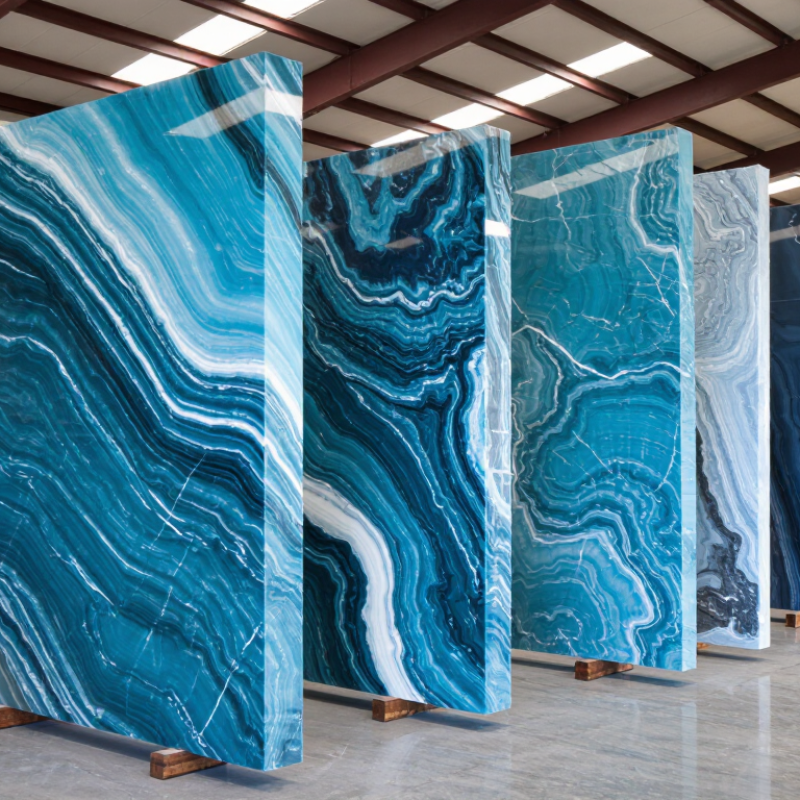
Azul Macaubas Quartzite is recognized by its cool blue background, flowing white bands, and occasional gray or golden movement. Each slab should be inspected under daylight. Strong backlighting can reveal translucent layers and hidden fissures. Do not trust the label alone. Some materials are sold as quartzite but perform more like marble.
A petrographic report can confirm mineral composition. It should identify quartz content, accessory minerals, weathering, and visible fractures. ASTM C97 testing measures absorption and density, while ASTM C880 evaluates flexural strength. These results matter for overseas façades, counters, and flooring. According to the USGS Mineral Commodity Summaries 2024, U.S. dimension-stone production reached roughly 1.6 million metric tons in 2023, valued at about 430 million dollars. The figure shows a substantial market, but it does not prove equal quality between quarries.
Check slab thickness, resin repair, bowing, and vein continuity before approval. A clear blue slab may become less consistent across a container. That is easy to underestimate. Record quarry lot numbers, photographs, test results, and crate conditions. The Natural Stone Institute’s technical guidance also stresses water absorption, strength, and finish evaluation before specification. My practical concern is simple: visual beauty can hide structural weakness. For global projects, test several slabs, not only one attractive sample.
Azul Macaubas is a natural quartzite recognized for its blue background, flowing white veining, high hardness, and low water absorption. The chart presents typical technical reference values for quartzite used in architectural projects. Natural-stone properties can vary between blocks and slabs, so final selection should be confirmed with a current laboratory test report.
How to Choose Azul Macaubas Quartzite for Global Projects?
Assess color under daylight, warm LEDs, and overcast conditions. Azul Macaubas can shift from blue-gray to softer turquoise. A small sample may hide that change. Request full slab photographs and, when possible, inspect the actual slabs before approval.
Veining deserves equal attention. Mark dominant lines on elevation drawings before cutting begins. Review how veins will meet across bookmatched panels, islands, and wall sections. Some movement looks elegant; too much can weaken the visual rhythm. I have seen attractive samples become confusing installations because the slab sequence was never documented. That mistake is avoidable.
Quality should be checked beyond appearance. Confirm thickness, edge integrity, resin repairs, fissures, and surface finish. Ask for recent test data covering water absorption, flexural strength, and stain resistance. An independent petrographic review can help verify the stone’s composition. Slab consistency also matters. Compare slabs from the same lot for background tone, vein density, thickness, and polishing response. Use written acceptance limits, not vague phrases like “similar color.” For international projects, record crate numbers, inspection dates, and packing conditions. Local fabrication teams need the same approved images and cutting plans. Even careful inspection has limits. Natural stone will vary, and expecting perfect repetition creates unnecessary disputes.
Choosing Azul Macaubas quartzite for global projects requires more than admiring its blue movement. The design must support the building’s purpose, climate, and maintenance plan. In hospitality interiors, its deep veining can define reception desks, feature walls, and carefully lit bathrooms. In quieter residential spaces, restrained bookmatching may prevent visual fatigue. The slab should serve the room, not dominate it.
Function changes by location. A kitchen island needs tested resistance to staining, impact, heat, and abrasion. A façade requires additional review of anchoring, freeze-thaw exposure, thermal movement, and panel thickness. Request project-specific test results for water absorption, flexural strength, and thermal cycling. Do not rely on a generic stone name. Natural variation matters. Two slabs from the same block may perform similarly but look completely different.
The 2023 UNEP Global Status Report for Buildings and Construction reports that buildings used about 34% of global energy and produced approximately 37% of energy and process-related emissions. This supports durable material choices that reduce replacement cycles, but transport distance still deserves scrutiny. Compare local fabrication, crate efficiency, and expected service life. Aesthetic judgment remains partly subjective. That is where early mock-ups help. View the quartzite beside flooring, daylight, artificial light, and hardware before approval. Small samples can mislead. Full-scale review is safer.
How to Choose Azul Macaubas Quartzite for Global Projects?
Supplier verification should begin before selecting a slab color. Request quarry origin, block numbers, recent petrographic reports, and chain-of-custody records. Compare test results under ASTM C97, C99, and C170 for absorption, flexural strength, and compressive strength. ISO 9001 certification can indicate controlled production, but it does not prove stone quality. Review the actual audit scope. The U.S. Geological Survey’s Mineral Commodity Summaries 2024 shows that dimension-stone markets depend significantly on international trade, making source transparency essential.
Availability requires more than a warehouse photograph. Ask for current slab counts, bundle dimensions, thickness tolerance, and reserved-block status. Confirm whether matching slabs come from one block. Natural quartzite varies, sometimes dramatically. A practical mistake is approving a sample while ignoring full-bundle variation. Request high-resolution images under neutral lighting and inspect filled fissures, resin repairs, and edge damage.
Tips: Build a shipping file early. Include commercial invoices, packing lists, country-of-origin documents, fumigation records, and verified container weight under SOLAS requirements. The World Bank’s Logistics Performance Index 2023 emphasizes customs efficiency, tracking, infrastructure, and delivery reliability. These factors can affect installation schedules as much as ocean transit. Use A-frame crates, moisture protection, corner guards, and shock indicators. Confirm unloading equipment at the destination. One overlooked detail can damage an otherwise excellent shipment.
| Evaluation Dimension | Recommended Requirement | Practical Data or Acceptance Range | Documents or Evidence to Request | Project Risk if Not Verified |
|---|---|---|---|---|
| Material identity | Confirm that the supplied stone is natural Azul Macaubas quartzite and not a visually similar quartz-based or engineered material. | Natural quartzite is a metamorphic stone composed predominantly of quartz; blue tones and veining can vary substantially between blocks. | Quarry or fabricator material declaration, petrographic description, dated slab photographs, and an approved physical sample. | Incorrect material classification, inconsistent appearance, or unsuitable performance expectations. |
| Supplier verification | Use a supplier with traceable quarry, processing, inspection, and export records. | Verify legal business details, export experience, production capacity, quality-control procedures, and at least two recent project references. | Business registration, factory or warehouse audit, reference list, inspection procedure, pro forma invoice, and signed commercial terms. | Fraud, undocumented substitutions, delayed production, or inability to resolve claims. |
| Quality certifications | Separate management-system certification from product-performance evidence. | An ISO 9001 certificate may support process control, but it does not certify the strength, absorption, or color consistency of a specific stone shipment. | Valid certificate, certification scope, issuing-body details, expiry date, and batch-specific test report. | Overreliance on a general certificate may hide batch variation or inadequate technical performance. |
| Technical testing | Request tests from an independent or technically competent laboratory using the project’s required standard. | Common dimension-stone tests include water absorption and bulk density, compressive strength, modulus of rupture, flexural strength, and abrasion resistance. | Current laboratory report identifying the stone, test method, specimen condition, results, and test date; ASTM C97, C99, C170, C880, or equivalent methods may be specified where applicable. | Unexpected breakage, staining, slipping, or non-compliance with architectural specifications. |
| Slab dimensions and finish | Approve exact thickness, finish, edge treatment, and allowable dimensional tolerances before production. | Common slab thicknesses are approximately 20 mm and 30 mm, subject to quarry and processor capability; actual thickness and tolerance must be confirmed in writing. | Shop drawings, slab-size schedule, finish sample, tolerance schedule, edge profile, and packing photographs. | Insufficient usable area, fabrication problems, installation delays, or visible finish differences. |
| Color and vein control | Approve a representative range rather than relying on one photograph or one small sample. | Blue intensity, white or gray veining, mineral patterns, fissures, and movement can differ from block to block and slab to slab. | Full-slab digital images, dry layout, slab numbering, vein-direction map, and written shade-variation allowance. | Client rejection, mismatched panels, and costly replacement after fabrication. |
| Stock and availability | Reserve material only after confirming the required quantity, usable yield, and matching sequence. | Availability is quarry- and block-dependent; “in stock” should mean physically identified slabs, not an unconfirmed future allocation. | Inventory list, slab identification numbers, current photographs, reserve agreement, production schedule, and replacement-stock plan. | Material shortage, shade mismatch, re-fabrication, or project schedule slippage. |
| Packaging and container loading | Require export-grade packing designed for heavy, fragile slabs. | Use strong A-frame or reinforced crate systems, separators, edge protection, moisture-resistant wrapping, and internal bracing; loading must remain within container and road limits. | Packing specification, crate dimensions, gross and net weight, loading diagram, container seal number, and time-stamped loading photographs. | Broken slabs, unsafe handling, port delays, overweight charges, or cargo claims. |
| Export documentation | Align commercial, customs, and shipping documents before dispatch. | Typical documents include commercial invoice, packing list, bill of lading, certificate of origin where required, insurance certificate, and export declaration. | Draft documents for buyer approval, correct HS classification, consignee details, country-of-origin information, and agreed Incoterms® rule. | Customs holds, incorrect duties, document amendments, storage fees, or delivery failure. |
| Transit and delivery planning | Build the purchase schedule around production, port handling, ocean transit, customs clearance, and inland delivery. | Lead time varies by stock status, fabrication scope, sailing schedule, destination, and customs procedures; obtain a dated milestone plan rather than a single delivery estimate. | Production completion date, booking confirmation, estimated departure and arrival dates, tracking details, delivery appointment, and contingency plan. | Missed installation windows, demurrage, storage costs, and liquidated damages. |
| Insurance and claims | Define responsibility for damage, shortage, concealed defects, and inspection costs. | Photograph crates before opening; record seal condition, visible damage, slab numbers, and quantity immediately upon arrival. | Cargo insurance certificate, claims procedure, inspection deadline, damage-report form, and agreed remedy or replacement terms. | Unrecoverable losses or disputes over whether damage occurred before or after delivery. |
| Installation and maintenance | Approve adhesives, grout, sealer, substrate, joint design, and maintenance instructions with the installer. | Quartzite may still require stain protection and compatible cleaning products; sealing frequency depends on porosity, use, finish, and the selected treatment system. | Method statement, product compatibility data, mock-up approval, sealer technical sheet, cleaning guide, and installer sign-off. | Etching or staining from unsuitable products, installation failure, and premature appearance deterioration. |

Note: Natural-stone properties, dimensions, appearance, availability, and transit times vary by quarry, block, processing method, shipment, and destination. Final acceptance should be based on project-specific samples, current batch documentation, and applicable local standards.
Estimate the landed cost before approving a slab. The U.S. Geological Survey’s 2024 Mineral Commodity Summaries reported approximately 1.9 million metric tons of U.S. dimension-stone production in 2023, valued near $430 million. These figures show why quarry availability, fabrication capacity, and freight conditions can affect pricing. For Azul Macaubas quartzite, request separate prices for blocks, slabs, cutting, crating, insurance, customs, and installation. Add a realistic allowance for breakage and unusable sections. My first project estimate was too optimistic.
Check the samples closely.
Compare at least three slabs under daylight, warm lighting, and wet conditions. Record the background tone, blue veining, fissures, resin repairs, thickness, and finish. A small sample cannot represent every slab. It may look perfect. That can mislead. Ask for recent production photos and matching slab numbers. Independent testing should follow relevant ASTM methods, including water absorption, density, and flexural strength. The Natural Stone Institute’s technical guidance also recommends reviewing test results alongside the intended application, not separately.
For international projects, confirm crate dimensions and container weight with the fabricator.
Then compare the result with the project’s structural limits. UN Comtrade classifies many worked-stone shipments under HS 6802, but this category does not isolate Azul Macaubas. Therefore, trade statistics cannot replace supplier documentation. Approve a physical mock-up before releasing the final purchase order, especially when several rooms require visual continuity.