| SPC Hybrid Flooring | A rigid core commonly made from PVC with mineral filler, often limestone. Exact formulations and layer construction vary by product. | Generally dense and firm underfoot. Its rigid core can help the floor bridge minor subfloor imperfections, but it does not replace proper subfloor preparation. | Usually designed to resist everyday changes in temperature and humidity better than many less-rigid flooring constructions. Performance depends on product specifications and installation conditions. | The flooring surface and core are generally water-resistant. Water can still affect joints, edges, or the subfloor if it reaches them; follow the product’s installation and maintenance instructions. | Commonly supplied as click-lock planks or tiles, with wood-look and stone-look designs. | Residential rooms and some commercial spaces, when the product’s wear layer, warranty, and installation requirements suit the intended traffic. | Check core thickness, wear-layer thickness, locking-system requirements, underlay compatibility, and permitted temperature range. A rigid core does not make every installation suitable for every subfloor. |
| WPC Hybrid Flooring | A wood-plastic composite core, typically containing polymer and wood-derived or other foaming components. Formulations differ among products. | Often feels somewhat softer or more cushioned than SPC, although the backing, underlay, and full construction also affect comfort and sound. | Its dimensional performance varies with the core formulation and product design. Follow the manufacturer’s acclimation, expansion-gap, and installation guidance. | The core and surface are commonly marketed for water resistance, but joints and the subfloor remain potential paths for moisture. Do not assume the installed floor is a waterproof barrier. | Commonly supplied as click-lock planks, including wood-look designs; available sizes and constructions vary by supplier. | Residential areas where a slightly more cushioned feel is preferred, subject to the product’s stated use and installation limits. | Compare the complete layer build-up, not core type alone. Review wear-layer details, acoustic backing, warranty exclusions, and moisture requirements for the subfloor. |
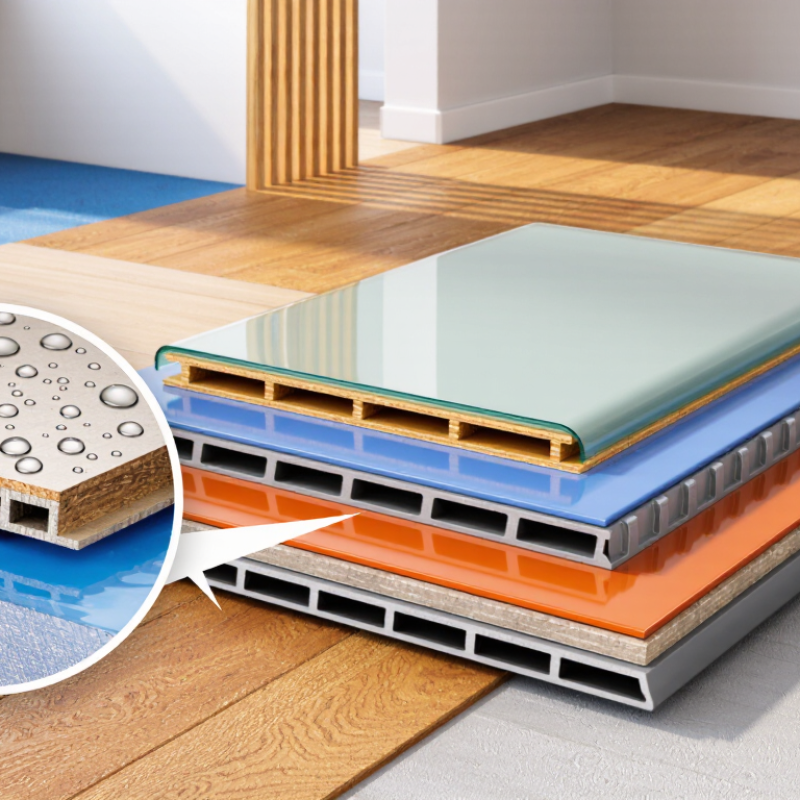
| Hybrid Flooring: Shared Construction | Typically combines a decorative layer, a protective wear layer, a rigid or semi-rigid core, and often a backing or attached underlay. The exact layer order and materials vary. | Feel and sound depend on core density, total thickness, backing, underlay, and the condition of the subfloor. | Expansion behavior is product-specific. Direct sunlight, temperature changes, large continuous areas, and installation details can affect performance. | Water resistance is not the same as a guaranteed waterproof room assembly. Protect the floor from standing water and install it according to the product instructions. | Planks and tiles are common; surface textures, dimensions, locking profiles, and edge details vary. | Choose according to room use, expected traffic, cleaning practices, and the manufacturer’s approved installation locations. | For a fair comparison, request technical data for wear layer, total thickness, core type, slip performance where relevant, fire classification, emissions, warranty, and test methods. |


 Your message must be between 20-3,000 characters!