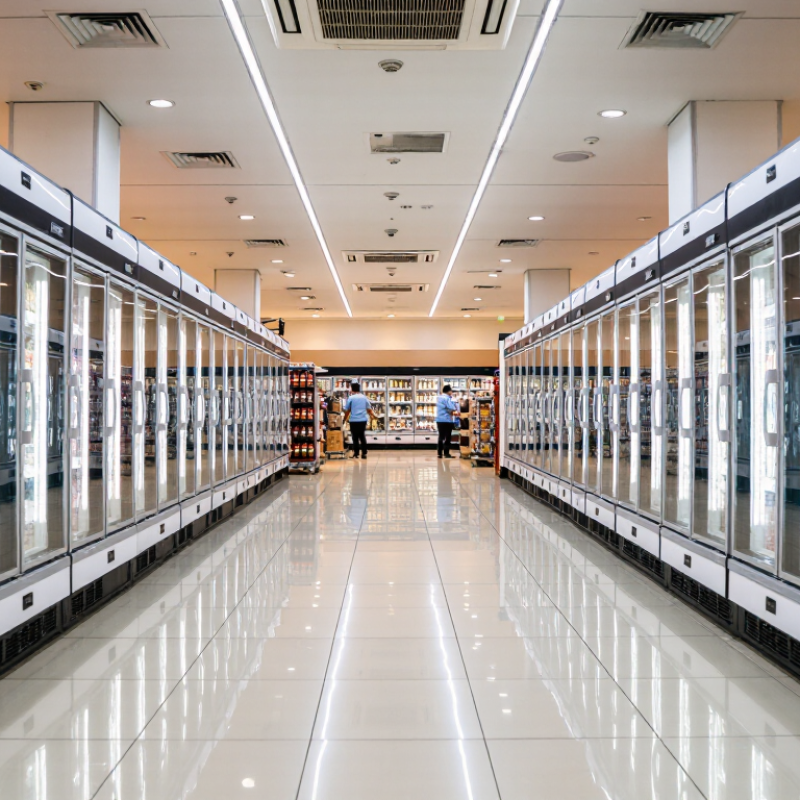
| Upright glass-door merchandiser | Typically around +2°C to +8°C; model and application dependent | Single- or multi-door cabinet for packaged drinks and chilled foods | Cabinet forming, insulated-panel assembly, door and gasket fitting, lighting and shelving installation, refrigeration-system integration | Temperature uniformity, door sealing, condensation control, energy-use data, and operation under the stated ambient conditions |
| Open multideck display cabinet | Often designed for chilled display, commonly about +2°C to +8°C | Open-front, multi-shelf cabinet for supermarkets and food retail | Long-cabinet assembly, air-curtain design, shelf and lighting installation, and provision for remote or self-contained refrigeration | Airflow performance, product temperature at specified loading, defrost behavior, and compatibility with the intended refrigeration system |
| Serve-over counter | Commonly configured for chilled display, approximately +2°C to +8°C | Front-service counter for deli foods, meat, seafood, or prepared items | Countertop and display-glass fabrication, refrigerated deck assembly, drainage design, and custom length or layout options | Product-zone temperatures, cleaning access, drainage, glass visibility, and the specified food-display application |
| Bakery or cake display cabinet | Chilled models are commonly set around +2°C to +8°C; ambient models also exist | Countertop or floor-standing glass display for cakes and pastries | Curved or flat glass fitting, shelf and LED-light installation, finish customization, and chilled or non-refrigerated model assembly | Whether the unit is chilled or ambient, humidity considerations, lighting heat, glass condensation, and usable display dimensions |
| Upright freezer merchandiser | Commonly designed for frozen storage near -18°C; exact set point varies by model | Glass-door cabinet for packaged frozen foods and ice cream | Thicker insulated cabinet construction, heated or anti-condensation glass options, refrigeration-system assembly, and frost-management design | Pull-down and recovery performance, frost and defrost behavior, door sealing, and temperature stability at the rated ambient temperature |
| Island or chest freezer | Usually intended for frozen products, often around -18°C or colder depending on design | Horizontal cabinet with sliding or hinged glass lids for retail floor display | Foamed cabinet production, lid and track fitting, basket installation, and static or fan-assisted system integration | Temperature recovery after lid opening, lid movement, insulation performance, drainage, and defrost requirements |
| Refrigeration and cabinet production capabilities | Not a product temperature specification | Capabilities may cover product design, sheet-metal work, foaming, assembly, and system integration | Factory scope can include cabinet fabrication, insulation foaming, refrigeration piping, electrical assembly, configurable dimensions, and private-label or OEM production | Verify in-house versus outsourced processes, sample approval, production traceability, applicable market certifications, and final inspection records |
| Quality and compliance verification | Depends on model, refrigerant, destination market, and test conditions | Applies across refrigerated display products | Potential checks include electrical safety inspection, refrigerant-circuit leak testing, temperature testing, and visual or functional inspection | Request valid certificates for the exact model and destination market; confirm test standards, refrigerant details, electrical ratings, and warranty terms |

 Your message must be between 20-3,000 characters!