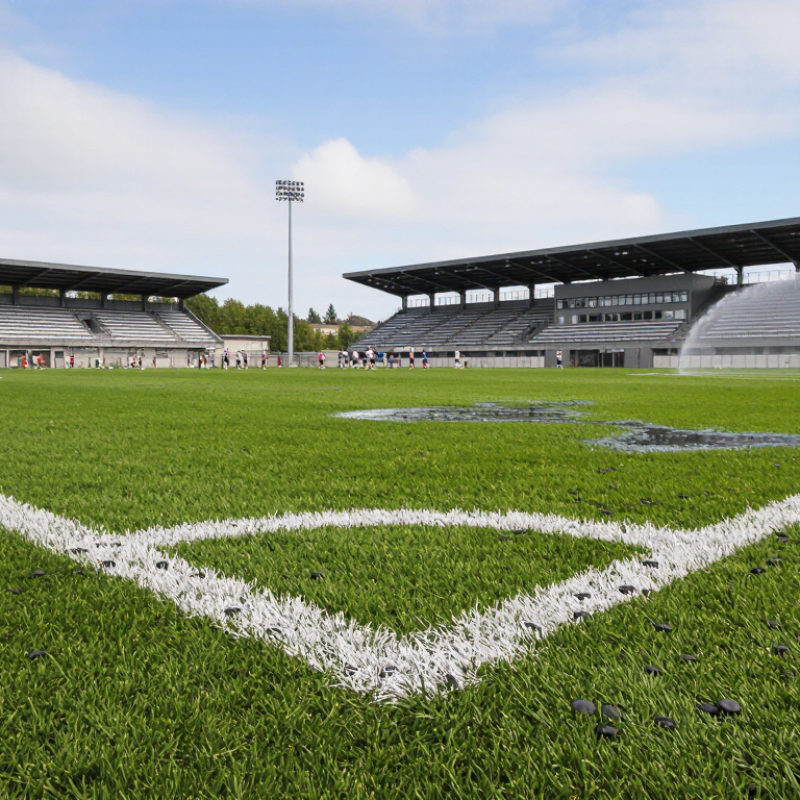
Choosing the best Football Fake Turf in 2026 is not simply a matter of picking the softest surface or the newest product. A school training ground, community pitch, and professional venue face different demands. The right choice depends on playing hours, climate, maintenance capacity, budget, and the athletes using the field. Small details matter: how the ball rolls after rain, how the surface feels underfoot, and whether infill gathers near the touchline.
Reliable comparisons should start with measurable performance, not marketing claims. FIFA’s Football Turf Quality Programme evaluates characteristics such as ball roll, shock absorption, vertical deformation, and rotational resistance. FIFA’s technical requirements provide a useful benchmark for comparing tested systems. ASTM International’s F1936 standard also addresses impact attenuation in installed turf systems. These documents help explain what a test measures; they do not prove that one product suits every site. That distinction matters.
A high rating is only part of the decision. Installation quality, drainage, infill depth, and routine maintenance can change how a field performs over time. A product may pass laboratory tests yet feel different after heavy use. That is worth questioning. This guide compares the practical criteria behind leading football surfaces, including durability, player comfort, ball response, upkeep, and total ownership cost. It also notes where available evidence is limited, because a confident label cannot replace field-specific evaluation. Before choosing, check current certification records and ask suppliers for test documentation tied to the exact system being offered.
Football fake turf is designed as a system, not just a green surface. Its main parts include synthetic fibers, backing, infill, and sometimes a shock-absorbing pad. Fiber shape and pile height affect how the surface feels underfoot. Infill helps support the fibers and influences traction and ball movement. These details matter during quick turns, short passes, and repeated play. A convincing appearance is not enough.
Turf is commonly classified by its construction and intended use. Some systems use longer fibers with infill, while others use shorter, denser fibers. The right choice depends on the game, expected foot traffic, climate, and maintenance capacity. Check the system’s test data and installation guidance, not just its product label. Requirements can vary by competition and location. I would also inspect sample areas in person; photographs can hide a surface’s stiffness.
Tips: Ask about drainage, infill levels, and routine brushing. Feel the surface with the footwear players will use. Small details matter. If the surface feels unusually firm, pause and ask why.
Which Performance Standards Matter for Football Turf in 2026
What Is the Best Football Fake Turf in 2026? Which Performance Standards Matter for Football Turf in 2026
The best football turf is not simply the softest or newest-looking surface. It should provide consistent ball roll, reliable traction, and impact absorption suited to the level of play. For competitive projects, check the current FIFA Quality Programme requirements and the exact test report for the proposed system. A certificate for one component does not prove the whole installed pitch meets the standard.
Tips: Ask for independent test results covering shock absorption, vertical deformation, rotational resistance, ball rebound, and ball roll. Check the tested system’s pile, infill, and backing match the installation. Ask how seams, drainage, and wear are inspected after use. Small details matter.
A pitch should also drain effectively and retain predictable performance as fibers and infill wear. Standards help compare results, but they cannot replace inspection of the finished field. I would not pretend one score settles every question. Request installation records, maintenance guidance, and a plan for retesting when conditions change. Walk the surface, too: loose infill, uneven seams, or standing water can signal problems that a tidy specification sheet may miss.
How Leading Football Turf Systems Compare
What Is the Best Football Fake Turf in 2026? How Leading Football Turf Systems Compare
There is no single best football turf system for every pitch. Long-pile infill systems use resilient fibres and loose infill to support traction and cushioning. Sand-dressed systems have less loose infill, while non-infill designs rely more on fibre structure. Each option feels different underfoot. Maintenance needs, climate, drainage, and playing hours all matter.
FIFA’s Quality Programme handbook sets measurable benchmarks for tested football turf. For example, FIFA Quality Pro criteria include 60–70% shock absorption and 4–8 metres of ball roll. These ranges help compare performance, but they do not guarantee identical feel across systems. A dry pitch may play differently from a wet one; real-world use deserves attention, too. Check the current FIFA handbook and the test results for the exact system being considered.
Tips: Ask for independent test reports, not just product claims. Walk the pitch, inspect seams, and check how infill behaves after play. Match the system to local weather and maintenance capacity. Small details matter. A specification can look excellent on paper, yet upkeep may prove harder than expected.
What Is the Best Football Artificial Turf in 2026? How Leading Turf Systems Compare
Pitch dimensions are a useful planning baseline for any football turf installation. The ranges below are set out in the IFAB Laws of the Game; they describe permitted field sizes, not turf performance ratings.
General matches allow a touchline length of 90–120 m and a goal-line width of 45–90 m. For international matches, the ranges are 100–110 m and 64–75 m, respectively. Choosing a turf system also requires checking the applicable football-surface performance requirements and the needs of the venue.
How to Choose the Best Turf for Different Football Fields
The best football turf depends on who plays, how often, and what lies beneath the surface. A full-size community pitch needs resilient fibers, stable infill, and drainage that clears heavy rain. For reference, FIFA’s recommended international field dimensions are 105 by 68 metres. Smaller training areas may benefit more from a shorter pile and firm footing than match-level speed.
Check independent test results, not just product descriptions. FIFA’s Football Turf testing evaluates factors including shock absorption, vertical deformation, and rotational resistance. Its criteria include a 55–70% shock-absorption range and 4–11 millimetres of vertical deformation, helping buyers compare playing comfort and surface response. Ask for test reports on the actual system, including turf, infill, and base. A good fiber alone cannot fix a poorly compacted foundation.
Climate changes the choice. Hot, exposed fields need a plan for surface temperature and water use; shaded, wet sites need efficient drainage and mold-resistant maintenance routines. For school fields with frequent practices, durability and easy repairs may matter more than a highly realistic ball roll. Watch players cut and turn during a trial. Small details count. I would still question any specification that promises low maintenance without explaining brushing, infill checks, and replacement intervals.
What Installation and Maintenance Require
A football fake-turf project succeeds or fails beneath the green surface. Before installation, check soil stability, drainage, and the base’s compactness. A weak or uneven base can leave soft spots, standing water, and seams that lift under repeated play. Details matter. The FIFA Quality Programme’s Handbook of Requirements evaluates fields using measurable performance tests. Depending on the category, its criteria include roughly 55–70% shock absorption and 4–11 mm vertical deformation. These figures show why installers should test the completed system, not just inspect the carpet.
Maintenance starts with routine inspection. Remove leaves and litter, check seams, and brush fibers so infill does not collect in heavily used areas. The Synthetic Turf Council’s maintenance guidance also emphasizes keeping infill distributed and scheduling deeper cleaning. Track the work: note the date, worn zones, and infill levels. It sounds tedious. Still, records can reveal a small problem before it spreads.
Frequency depends on use, weather, and the system installed; one calendar cannot fit every pitch. Ask the installer for a site-specific maintenance plan and testing documentation. FIFA’s testing benchmarks are not a substitute for local checks or manufacturer-neutral field assessments. One imperfect habit is waiting until the surface looks bad. By then, uneven infill or compacted zones may already affect footing. Regular measurements help, even when the results are inconvenient.