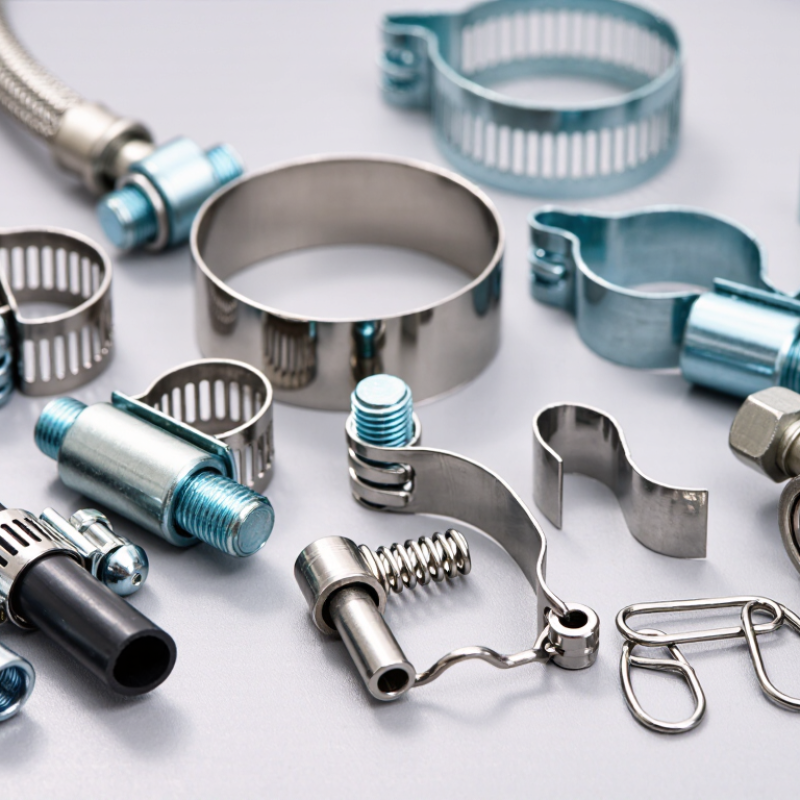
| Worm-Drive (Band) Clamp | A perforated or embossed band tightens around the hose when a screw engages with the band. Adjustable and generally reusable. | Stainless steel band and housing; stainless or plated-carbon-steel screw. Common stainless grades include 304 and, for greater corrosion resistance, 316. | General-purpose connections in automotive, plumbing, irrigation, and industrial service. | Check hose diameter range, band width, edge finish, and material compatibility. The screw and band should be tightened evenly without damaging soft hose. |
| T-Bolt Clamp | A wide band closes with a T-shaped bolt and nut, typically with a spring or bridge feature to maintain a secure, even circumferential load. | Stainless-steel band, bolt, and nut; some designs use plated or coated steel components. | Large-diameter or heavy-duty hose connections, including charge-air, industrial, and certain vehicle systems. | Choose a size and band width suited to the hose and connection. Confirm the clamp is designed for the system’s pressure, vibration, and temperature conditions. |
| Spring-Band Clamp | A formed spring-steel ring applies radial force and can accommodate modest hose-diameter changes as temperature varies. | Heat-treated spring steel, often with a corrosion-resistant coating; stainless spring steel is available for demanding environments. | Factory-installed automotive and appliance hose connections, especially where temperature cycling occurs. | Requires compatible hose geometry and suitable installation access. Verify the clamp’s operating range and corrosion resistance for the environment. |
| Constant-Tension Clamp | Uses a spring element, often combined with a band and bolt, to help maintain clamping force as the hose expands or contracts. | Stainless-steel band and hardware with a spring element made from spring steel or stainless spring material. | Hose assemblies exposed to temperature swings, vibration, or changing operating conditions. | Spring travel and clamp size must match the hose and connection. It does not replace proper hose selection or system-level pressure validation. |
| Ear Clamp | A one-piece band is tightened by crimping one or more raised “ears” with a suitable tool. The installed joint has a compact profile. | Stainless steel or zinc-coated carbon steel, depending on the required corrosion resistance and application. | Small-bore tubing and hose assemblies in automotive, appliance, and fluid-handling applications. | Installation usually requires a dedicated crimping tool, and removal may damage the clamp. Select the correct size for the hose and fitting combination. |
| Wire Clamp | One or two formed wire loops tighten around the hose, concentrating force along narrow contact areas. | Spring steel, plated steel, or stainless-steel wire. | Selected low-profile connections and applications where a narrow clamp is appropriate. | Confirm that the hose can tolerate the localized contact pressure. It may be unsuitable for hose constructions that require a broad, evenly distributed band. |
| V-Band Clamp | A V-shaped band draws matching flanges together when tightened, creating a quick-release joint between flanged components. | Stainless steel or plated steel; material selection depends on temperature, corrosion exposure, and joint requirements. | Flanged exhaust, turbocharger, ducting, and process-equipment connections. | Designed primarily to secure mating flanges rather than clamp a hose directly. Flange profile, alignment, temperature, and sealing method must be compatible. |
| Buyer note: Clamp performance depends on the hose, fitting, installation method, operating temperature, vibration, and fluid or environmental exposure. Verify dimensions, material specifications, and suitability against the equipment manufacturer’s requirements before purchase. |


 Your message must be between 20-3,000 characters!